
How to hack a WiFi password?
Here are a few methods used by hackers to hack a WiFi password.

PASS WIFI is the software able to hack any WiFi password for any device. It scans and decrypts the key (wep or wpa) and shows you the password on the screen.
This video shows you how to hack a WiFi password thanks to PASS WIFI:
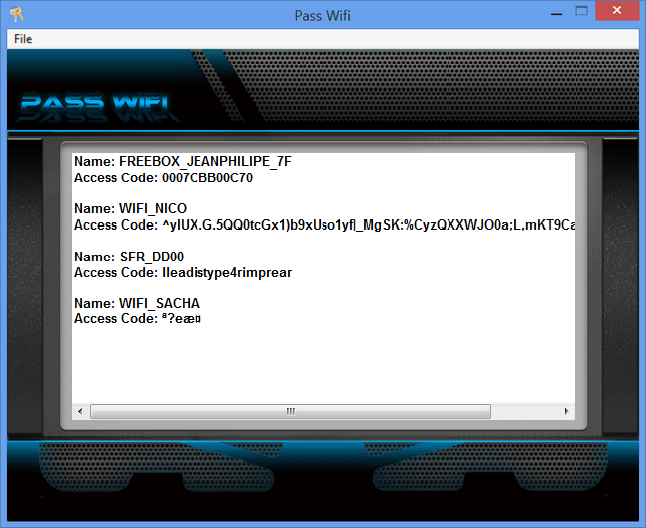
You can download PASS WIFI here: https://www.passwordrevelator.net/en/passwifi
Accessing a WiFi network that is not yours without authorization is illegal. This content is educational and meant to help you recover your own key or that of a loved one.
The second method consists in trying to enter the servers with the help of passwords. A software will try, until finding the right combination of “username / password”. To get these different passwords, there are several possibilities:
– brute force attack : this is the one that comes to my mind, but it is used as a last resort because it takes a lot of time. Indeed, this method consists in testing all the password possibilities one by one by creating them with all the characters.
– attack with a list or a dictionary: this method is widely used and works in more than 50% of cases, because users often choose existing words or first names.
– hybrid attack: Many users strengthen their passwords by adding, for example, the date of birth of a child. The hybrid attack will use the words from the list by adding numbers such as: paris1998.
These programs are often used in companies to test the passwords of employees. In this case, the software directly compares the result of an encrypted password, to the password also encrypted. If the result is the same, then we can consider having found the password. Those whose password is too weak or too easy to find will have to change it. For more information, here are some famous software: “L0phtCrack”, “John the Ripper”, “THC Hydra”, “Brutus” but there are many others.
If you have read the articles on services and ports on a server, you will easily understand that exchanges between computers go through these ports. But connections also go through these ports.
There are many tools that are used to scan open ports (those that the firewall allows). These ports are open for working services and hackers will try to connect through one of these ports if it is left involuntarily or intentionally open. From the first scan, it is easy for the hacker to know what type of OS is installed (Linux, Windows, Mac…) and its version. From this information, he can try to use one of the security vulnerabilities of the OS concerned. (This is why computers must be up to date: to fix the security flaws discovered every week).
Once connected, and if he connected with the super-user (root under Linux, and administrator under Windows), he will have access to the entire machine (and to all the servers of the network, if he connected with the domain administrator).
The hacker must try to leave no trace, and especially to provide a backdoor (backdoor), in case he wants to come back. The hacker can come back through this backdoor even if in the meantime the network administrator has closed the port through which the hacker entered the first time.
To check that you cannot be hit by these attacks, do it like hackers and scan all the open ports, then:
– close all those that are useless,
– make sure that those that must stay open are secure.
Social engineering
Social engineering is a method to get information on the company you want to attack, but unlike other methods, it attacks the human. The advantage of this method for hackers is that it does not necessarily require a lot of computer skills. Indeed, in computer security, the human factor is often forgotten by companies, so it is a breach through which hackers rush.
Social engineering is the set of actions that will be put in place to get confidential information or to enter a system. Here are a few examples for you to better understand what it is:
A hacker can try to call the switchboard as another person in the company (if possible a very senior person, to impress the poor person at the switchboard) and try to recover important information.
– He can also try to impersonate someone in the IT department and ask a user for the login and password.
– He could also try to pretend to be an IT supplier who needs to access the network and needs to create a user account.
– Use a bit of charm on the person at reception, and ask for some confidential information, or try to connect to a local network.
– But the hacker may want to send an email containing an infected attachment to create a flaw to enter the system.
The list of possible scams is very long… I leave you to imagine a few of them.
In addition, there are toolkits that let you use this system, take a look at “Social Engineering Toolkit”, including the tool “SET” which lets practically anyone become a hacker! This type of tool can even recover (through fake websites such as fake facebook) the login credentials of users.
Social engineering is a flaw often ignored, only large companies try to train their employees against this threat.
To protect yourself from this kind of attack, you must try to understand all the mechanisms of hackers, be careful, and above all do not believe everything we are told.